|
Imply vs. Infer: What Do They Mean?
|
|
The words imply and infer are related. They are also often used as synonyms or incorrectly swapped to mean the other thing. Today we'll help clear confusion concerning these two words.
The Difference Between Imply and Infer
To imply something means to suggest it indirectly. It's a way of giving information that allows another person to deduce or otherwise determine something on their own. Let's look at a couple of examples:
Kevin has never been known for his punctuality.
This sentence implies that Kevin is frequently late by not stating the observation directly. Depending on the message receiver, this information might lead someone to think that Kevin is disorganized.
I wanted to attend the party, but I put my studies first.
This sentence could imply that those who did attend were less concerned about getting good grades.
It was supposed to be a family-sized pizza, but Jon finished it before we arrived.
This sentence can imply that Jon did not think of others and ate more than he should have. |
Not all implications are negative or judgmental, but you may often find them used that way in literature or the media. Negative implications can also be the easiest to detect in writing or speech.
To infer something means to draw a meaning or conclusion that wasn't explicitly stated; in other words, it is the act of interpreting an implication, making it the response to information that may not have been directly conveyed. When one person implies something, another person can infer it.
As an example, suppose you confuse the words your and you're in a sentence and someone refers you to our website without coming right out and saying you were wrong. They may be implying that your grammar needs improvement. At the same time, you could infer from their suggestion that you need to work on some finer points of your writing.
Infer and Imply Usage Examples
Infer is not a synonym for imply. Imply is done by a speaker or writer—specifically, one who is being indirect: She implied that I'm a fool means that she didn't come right out and say it, but she got her point across.
Infer is done by a perceptive listener or reader who "catches" your meaning: I infer that you think I'm a fool.
Imply is akin to suggest and insinuate; infer is akin to deduce and conclude.
Why Do We Imply and Infer?
Although the concepts behind imply and infer are easy to understand, you might wonder why we use them at all. After all, good writing is usually direct.
While we should always aim to be clear, implying and inferring sometimes help us maintain a balance of social awareness and propriety. Some people do not see the advantage of being direct, and some people may not be receptive to such directness. This can be why we suggest but do not outright state something: We might prefer that the message receiver be able draw a fitting conclusion themselves.
While some inferences can be wrong or misinterpreted, someone who is able to consider deeper subtexts from messages and information can sometimes have an advantage over another person who accepts most communication at face value.
In other words, the better we get at "reading between the lines," the more adroit we can be in assessing ideas and opinions, as well as what we might gain from them in our mission to be better readers, listeners, and communicators.
|
View and comment on this
article on our website.
|
|
|
|
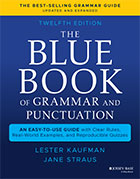 |
The Blue Book of Grammar and Punctuation
by Lester Kaufman and Jane Straus |
The Authority on English Grammar! Twelfth Edition Now Available
An indispensable tool for busy professionals, teachers, students, homeschool families, editors, writers, and proofreaders.
Available in print AND as an e-Book! Over 2,000 copies are purchased every month!
To order the book, simply click the link to order the book from the GrammarBook.com website.
|
Free BONUS Quiz for You!
[[firstname]], because you are a subscriber to the newsletter, you get access to one of the Subscribers-Only Quizzes. Click here to take a Subject and Verb Agreement with Collective Nouns Quiz and get your scores and explanations instantly!
We will be adding many more quizzes this year to our already substantial list of them. If you have suggestions for topics we have not yet covered, please send us a message at help@grammarbook.com.
|
Hundreds of Additional Quizzes
at Your Fingertips
Subscribe now to receive hundreds of additional English usage quizzes not found anywhere else!
Teachers and Employers
Save hours of valuable time! You may assign quizzes to your students and employees and have their scores tallied, organized, and reported to you! Let GrammarBook.com take the hassle out of teaching English!
"Fun to test my skills."
"The explanations really help ... thanks!"
"I can select the quizzes to assign to my students, and then the results are reported to me automatically!"
If you think you have found an error in a quiz, please email us at help@grammarbook.com
|
Wordplay

|
 |
English in a Snap:
68 One-Minute English Usage Videos FREE |
Learn all about who and whom, affect and effect, subjects and verbs, adjectives and adverbs, commas, semicolons, quotation marks, and much more by just sitting back and enjoying these easy-to-follow lessons. Share them with your colleagues (and boss), children, teachers, and friends as well! Click here to watch.
|
|


