|
Is the Plural of Mango "Mangoes" or "Mangos"?
|
|
Sometimes with English, even when we think we know how to use and spell a word correctly, different forms of it can spring up and trip us.
Mango can be one of those words when we are writing its plural. Should it be mangoes or mangos? That's not a fruity question, but rather one we can answer right now.
Why Mango (and Words Like It) Can Be Tricky
If you ever find yourself confused in writing the plural of mango, you aren't alone. The spelling issue can cause pause because conflicting guidelines are at play.
Many nouns that end with a consonant + "o" will form the plural with a simple "s": pianos, memos, concertos. At the same time, as it can tend to, English spelling creates its own exceptions by adding an "e" to the plural of some words ending in "o": heroes, vetoes, tomatoes. This thwarts a go-to guideline.
Compounding the confusion, different resources might assign or allow for either plural depending on the writer's preference: e.g., writers can use avocados or avocadoes.
Which brings us back to our original question:
| Is the Plural of Mango "Mangoes" or "Mangos"? |
How Do We Spell the Plural of Mango?
The immediate answer is that either mangos or mangoes can be correct, and you are the final judge of which to use. You might have days when you use mangos and others when you opt for mangoes. You can however consider a couple of things before you use them interchangeably.
The first is that the shorter spelling (mangos) is generally preferred in the U.S. Because the spelling is so common, some educators and style authorities may perceive the longer version, mangoes, as incorrect.
The second item of note is that different dictionaries, style guides, and publication guidelines may call for one spelling over another. For example, your teacher at school or your in-house style guide at work may prefer mangoes. If this is the case, there's no reason to debate the issue: You can simply follow suit.
As with all else concerning grammar in American English, our aim is to be consistent with our choices of spelling and style. Once you decide to use mangos or mangoes, stick with the spelling unless you have a reason to change it.
|
View and comment on this
article on our website.
|
|
|

|
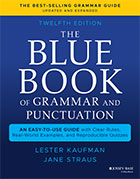 |
The Blue Book of Grammar and Punctuation
by Lester Kaufman and Jane Straus |
The Authority on English Grammar! Twelfth Edition Now Available
An indispensable tool for busy professionals, teachers, students, homeschool families, editors, writers, and proofreaders.
Available in print AND as an e-Book! Over 2,000 copies are purchased every month!
To order the book, simply click the link to order the book from the GrammarBook.com website.
|
Free BONUS Quiz for You!
[[firstname]], because you are a subscriber to the newsletter, you get access to one of the Subscribers-Only Quizzes. Click here to take a Pronouns Quiz and get your scores and explanations instantly!
We will be adding many more quizzes this year to our already substantial list of them. If you have suggestions for topics we have not yet covered, please send us a message at help@grammarbook.com.
|
Hundreds of Additional Quizzes
at Your Fingertips
Subscribe now to receive hundreds of additional English usage quizzes not found anywhere else!
Teachers and Employers
Save hours of valuable time! You may assign quizzes to your students and employees and have their scores tallied, organized, and reported to you! Let GrammarBook.com take the hassle out of teaching English!
"Fun to test my skills."
"The explanations really help ... thanks!"
"I can select the quizzes to assign to my students, and then the results are reported to me automatically!"
If you think you have found an error in a quiz, please email us at help@grammarbook.com
|
Wordplay

Literally, a fork in the road
|
 |
English in a Snap:
68 One-Minute English Usage Videos FREE |
Learn all about who and whom, affect and effect, subjects and verbs, adjectives and adverbs, commas, semicolons, quotation marks, and much more by just sitting back and enjoying these easy-to-follow lessons. Share them with your colleagues (and boss), children, teachers, and friends as well! Click here to watch.
|
|


