So maybe you do know how to add memory to your computer or program your cell phone, but do you know where to put a comma in a sentence?
If you have a sentence followed by a list, do you use a semicolon or a colon? Does the period go inside or outside of quotation marks? How do you keep up with changing rules of grammar and punctuation when you can't remember where to put the apostrophe?
People often fear punctuation because the rules have changed and they continue to do so.
Rumor has it that the rules about placing periods and commas inside quotation marks was changed about 30 years ago by the typesetters' union because figuring out inside vs. outside for the comma or period was too complicated and time consuming. The British apparently didn't buy this excuse and continue to follow logic. We still have to use logic with quotation marks when the sentence has question marks, exclamation points, or, heaven forbid, a semicolon.
What To Do
Question: Do you use a semicolon or colon with a list?
Answer: That depends. Did you introduce the list with an introductory word such as such as? Did you have a complete sentence before you began the list? Is your list part of your sentence or did you indent the items on the list in tabular form?
To Apostrophe or Not to Apostrophe
A helpful tip for one of the most confusing issues for most of us:
It's vs. its
It's is a contraction for it is. If you cannot substitute it is for its, then don't use the apostrophe.
Example: It's a good thing you have access to the rules now.
Example: Knowing the rules is worth its weight in gold.
A common mistake in reports, and websites is the overuse or inappropriate use of commas. There are just so many rules about commas that you have to be dedicated to learning the rules or have a handy reference that gives you real-world, clear examples along with rules written for all of us who did not major in English.
Type Oh!
What about those annoying red and green squiggly lines we see under words and punctuation marks? Often, when you right-click on the squiggly line, you will receive a suggestion that is confusing or just plain wrong.
And while you might not think it's a big deal, businesses that do not have their websites, letters, and advertising copy proofread pay a hidden price in customer confidence and profits.
The bottom line is that the English language is a living, breathing entity, much like an animal responding to its environment. It must adapt in order to survive.
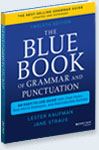
The Blue Book of Grammar and Punctuation is an easy-to-use reference guide and workbook by Jane Straus, an entertaining teacher, lecturer, and author. Do you need this book? Try one of the Interactive

Tests to find out. Receive your scores and the correct answers
instantly.
To order the book(s), click here.
Discounts for multiple copies and for bookstores.